

The Efficiency Dilemma
“A measurable improvement does not tell us, by itself, whether the whole has improved.”
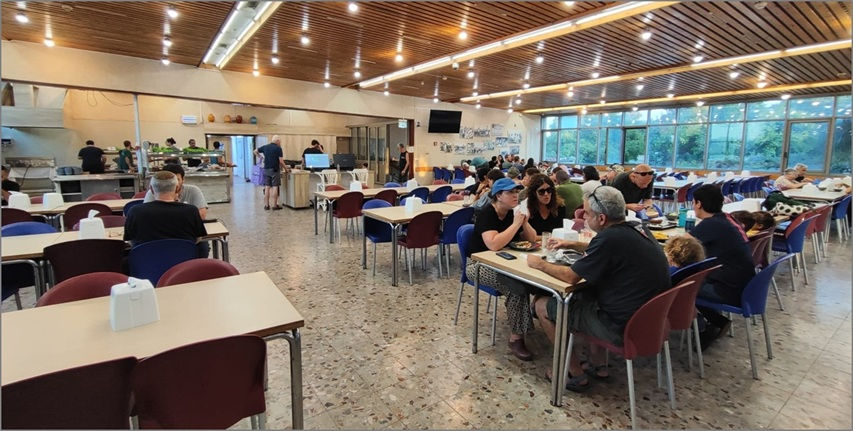
Empty Dining Room
Some of my most vivid memories of the Kibbutz dining room are not of crowded holidays or celebrations, but of evenings when almost nobody came. Like other Kibbutz members, I occasionally finished my normal workday and went to do my evening duty in the dining room. We had to arrange the food on the serving carts, prepare the hall, and later clean everything and put it back in place. After a full day's work, standing there surrounded by food, equipment, empty tables, and a large hall prepared for many more people than had come, it was hard not to wonder why we were still doing this.
Back then, there was a perfectly reasonable explanation for the declining attendance. The Kibbutz had prospered, and our homes had changed accordingly. Families now had proper kitchens, refrigerators, ovens, and everything needed to prepare their own meals, so dinner increasingly became something many families preferred to eat at home, especially on cold winter evenings. This was very different from the conditions under which the first Kibbutzim had been established, when members often lived in tents or very modest rooms and individual homes had little capacity to prepare meals independently. Under those circumstances, a common kitchen and dining room offered a practical solution for feeding the community.
At the time, I saw little reason to question the logic of what was happening; much of it seemed like evidence of success. The pioneers had lived under conditions that required many activities to be organized collectively because individual households had so little of their own, whereas their children and grandchildren now lived in comfortable homes and could make choices earlier generations simply did not have. If families preferred to eat dinner together at home and could do so easily, operating a large dining room for only a few evening diners increasingly seemed an obvious inefficiency. The gradual introduction of personal food budgets and greater individual responsibility for consumption also seemed consistent with this changing reality. At the same time, as attendance at some meals declined, the labor, equipment, energy, and preparation required to provide them were spread across fewer diners, making the arrangement increasingly difficult to justify.
In Tzuba, where I grew up, became a member, and still follow these changes closely, they mainly reduced the meals with the fewest participants. Lunch continues as before, while breakfast is no longer served and dinner is now offered only three evenings a week. In many other Kibbutzim I know personally, including Ayelet HaShahar, where my father grew up, the progression continued much further. Dinner disappeared, then breakfast and lunch, until eventually regular meal service ceased and the dining room itself closed. The building had once been used several times a day, but as regular use declined, the question of how much the community should continue investing in its maintenance became increasingly difficult to avoid.
Only later did I notice that the dining room provided more than food. For decades, it had also been the obvious place for holidays, celebrations, large meetings, and other occasions when much of the community gathered. Nobody necessarily had to decide that this was one of its important functions; it had simply become so over time. As regular use declined substantially, and in some Kibbutzim disappeared altogether, maintaining such a large building for less frequent occasions became harder to justify, and in some places its role in community life diminished as well.
Watching this unfold across different Kibbutzim gradually changed how I understood my own experience in the dining room in Tzuba. I had seen firsthand the work and resources required to prepare evening meals for only a few diners, and I understood why reducing them seemed reasonable. In other Kibbutzim, however, I could also see what happened as similar changes continued much further. That made me less certain that the cost of providing meals captured everything that mattered. When I had stood beside the serving carts, waiting while only a few diners arrived, the empty tables had seemed to provide their own answer. Years later, that answer no longer seemed quite as simple, and I began to wonder: "What exactly had the dining room been providing?"
What Else Changed?
For many years, I did not connect what was happening in the dining room with other changes taking place in the Kibbutz. Each had its own history, its own reasons, and often advantages that were easy to understand at the time. One of the most significant changes concerned how children lived. When I was growing up, children slept in children's houses rather than in their parents' homes, but from about four in the afternoon until eight in the evening we had what we called "family time." During those hours, we were with our parents, usually at home or elsewhere around the Kibbutz, and we could eat dinner together as a family or with friends in the dining room. At around eight, our parents took us back to the children's house, helped us brush our teeth and get ready for bed, and often read us a story or sang us a song before saying goodnight and leaving.
At the time, this was simply the rhythm of life as I knew it. I did not think about how, every evening, parents from across the Kibbutz walked to the children's houses at roughly the same time. They came because their children were there, but the routine also brought them into contact with one another. Someone who had spent the day in the orchard might meet someone from the factory, kitchen, office, or school, while parents whose work and private lives otherwise gave them little reason to meet could still cross paths almost every evening. Later, when children began sleeping in their parents' homes, family life changed in ways many parents and children wanted, but one ordinary reason that had kept bringing parents from across the community together also disappeared. Nobody had set up the children's houses for that purpose, just as nobody ended communal sleeping to reduce those encounters.
Only much later did I realize that the children's houses were not the only part of Kibbutz life that produced these repeated encounters without anyone deliberately designing them. The dining room created a similar pattern in a different way. Members went there because it was time to eat, not because they had decided to meet people from other parts of the community. I remember that, at almost every meal, the people sitting beside me at the table were different. Some members preferred to sit regularly with the same people, but there was always a mix: chance encounters, new conversations, and information and gossip passing freely between people as they ate, without anyone organizing it and without clear barriers between groups.
These changes had different origins: moving children into their parents' homes concerned family life, while reducing communal meals reflected shifting living conditions, preferences, costs, and consumption patterns. Yet both also affected how often members of different parts of the community crossed paths. People still met at work, in committees, at the swimming pool, in the library, at community events, and in one another's homes. Work mainly connected people who already worked together, committees involved those serving on them, and places such as the swimming pool or library brought together those who chose to be there. The dining room and the children's houses required no such choice; everyday life itself repeatedly brought people into contact with others they might otherwise have had little reason to see.
Only in retrospect did I recognize the common element I had missed. The changes served different purposes, and each made sense on its own terms, yet together they were altering the everyday patterns through which people from different parts of the community continued to meet. At the time, however, I remember being uncertain about how to judge changes that seemed reasonable one by one. Were they improvements? By what measure could I tell? What should I have been looking at beyond the immediate problem each change was meant to solve?
That uncertainty did not tell me whether any of those changes were right or wrong, nor did it suggest that the old arrangements should have been preserved. Instead, it gradually led me to a different question, one I had not known to ask while the changes were underway. If arrangements created for entirely different practical purposes were also producing effects no one had deliberately intended, how would we know what else we were altering when we changed them?
Improving What?
That uncertainty left me with a broader problem: before deciding whether a change is an improvement, how do we know what to include in the evaluation? This question is not unique to a Kibbutz. Imagine your parents invite you and your family for a holiday meal. Preparing and serving it may require hours of shopping, cooking, setting the table, and cleaning on their end, while you may have a long drive to get there. But then, looking at the gathering purely from an economic perspective, your parents reconsider. They call and offer to transfer to your bank account the money they would have spent on the meal, so you can take your family to a nice restaurant closer to home. They further explain that this way you avoid the long drive, they avoid much of the work involved in preparing and hosting the meal, and they even point out that there would still be money left over for other things. If the objective is simply to provide a good meal at the lowest practical cost, the alternative may be hard to challenge. Yet very few of us would regard the two arrangements as equivalent, because the holiday meal does something that cannot be found on the plate: it brings generations together, renews relationships, and creates shared memories. This does not mean that every contribution of the gathering is valuable enough to preserve, or that the gathering itself must continue. It means only that these contributions need to be visible before they can be evaluated alongside the alternatives.
Now imagine the same reasoning within a company. Once a year, employees from different departments gather for an event that requires travel, lodging, meals, and time away from regular work. A manager reviewing the numbers might reasonably ask: why not cancel it, keep everyone at work, and add some of the money saved to employees' salaries? From a narrow economic perspective, the alternative can look attractive. Yet the gathering may also be one of the few occasions when people from different departments spend unstructured time together, exchange information, start conversations, or build relationships that rarely emerge through their formal roles. Again, this does not necessarily mean the gathering should continue. It means that before deciding whether replacing it is an improvement, we need to know what else the company may be changing, along with the cost and working time it can easily measure.
This made me realize that the problem can begin before we make any calculation. If we see a family meal mainly as a way to feed people, a company gathering mainly as time away from work, or a dining room mainly as a way to serve meals, then other things those arrangements contribute may never enter the evaluation. I call this Functional Reduction: reducing our understanding of an arrangement to its most visible function. That function may be real and worth improving, but if it is the only one we consider, the comparison is incomplete before it even begins.
But even after we broaden what we include in the evaluation, another problem remains: improving one part does not necessarily improve the whole. Eliyahu Goldratt made this a central idea in his Theory of Constraints. A department can meet its own target, or a stage of a process can perform better, without improving the performance of the larger system. The important question is therefore not only whether a part improved according to its own measure, but whether the system improved as a result.
The previous column reached a similar conclusion from a different angle. We saw that replacing people with individuals who appear better suited to each role does not necessarily make an organization more capable, because some capabilities develop through relationships, shared knowledge, and ways of working together. The same idea applies more broadly: some capabilities do not exist in any single part but in the relationships that allow different parts to work together.
But that still leaves a harder question. Functional Reduction helps us avoid overlooking what else may be changing, and Goldratt helps us see why improving one part may not improve the whole. Yet neither tells us what improving the whole actually means or what benchmark we should use to judge the changes and "optimizations" we want to make within a system. This leads to a critical insight: a change can be measured without knowing the system's objective, but it cannot be judged as an improvement without a benchmark. And that benchmark for the whole cannot come from the economics or performance of any single part; it must come from what the system is trying to sustain or develop, and what it is trying to become.
Efficient for What?
This fundamentally changed how I thought about efficiency itself. Lower costs, less labor, or greater output can all be measured, but whether they constitute an improvement depends on what we are trying to achieve. Efficiency therefore has meaning only in relation to an objective: efficient for what?
Imagine an organization whose purpose is to provide meaningful employment for people with disabilities. A manager discovers that machines could perform much of the work faster, more cheaply, with fewer errors, and with greater output. By those measures, automation seems like an obvious improvement. But if meaningful employment is part of what the organization exists to provide, eliminating those jobs could improve production while making the organization worse at fulfilling its purpose.
Now imagine the same workplace with a different purpose: to produce as much as possible, at a defined quality level, with the resources available. In that organization, the same automation may be entirely consistent with its goals. The technology and measurable production results can be identical; what changes the meaning of the decision is the objective.
The benchmark we seek must therefore come from what the organization is trying to sustain, develop, or become. In the ULIC framework, I call this Direction. Mission, Purpose, Vision, Values, and Shared Futures are among the ways human organizations articulate and sustain Direction. Their practical importance is that they allow us to ask not only whether something has become cheaper, faster, or more productive, but also whether the change moves the organization toward or away from what it is trying to achieve. Direction, therefore, provides the benchmark for judging whether better performance in one part actually improves the system as a whole.
The early Kibbutzim may not have used today's language of Mission, Vision, and Purpose, but their Direction was clear. They sought to build a particular kind of community and society, and their economic and social arrangements were understood in relation to that larger aspiration. This did not mean every arrangement had to remain unchanged, but it gave the community a broader reference against which changes could be judged.
The problem with organizations is that no one knocks on management's door and says, "Did you notice that for a while now you have been operating without a clear Direction?" When Direction becomes unclear, or even disappears altogether, decisions do not stop. The organization keeps moving on its own inertia, as if nothing has changed, even when no one is quite sure where it is heading. Resources continue to be allocated, activities continue, buildings are maintained, and old arrangements are reconsidered. Measures such as cost, utilization, and output are useful because they are concrete and easy to compare. But for that very reason, they can gradually substitute for the missing benchmark without anyone consciously deciding they should. What began as a measure can eventually become the objective, without anyone noticing when the change occurred.
This is where Functional Reduction becomes especially consequential. Once an arrangement is understood primarily through its most visible function, and there is no clear Direction against which to judge change, it becomes natural to optimize that function according to the measures attached to it. Each decision may make sense on its own, while their cumulative effect gradually reshapes the system in ways nobody intended.
In Universal Law of Increasing Complexity (ULIC) terms, Direction provides the trajectory against which change can be judged, while Structure shapes the relationships and capabilities that become possible. Structure can change, sometimes substantially, without altering Direction. The problem arises when local measures progressively reshape Structure and, over time, begin to shift the trajectory of the whole without anyone consciously deciding to change Direction.
This brought me back once again to the nearly empty dining room. The cost per meal was real and worth knowing, but it could tell me only about the cost of providing dinner in that particular way. It could not tell me what the Kibbutz as a whole needed to sustain, develop, or become, nor whether the dining room was still the right Structure through which to support those needs. That required a broader reference: what kind of community did we want to become, and what did such a community still need to be able to do?
When Direction is clear, we can judge changes against what the system aims to achieve. When Direction is unclear, what is easiest to measure can gradually become what we pursue.
What Remains?
Recognizing what else an arrangement makes possible does not mean that the arrangement itself should remain. The circumstances that created the Kibbutz dining room have genuinely changed, and Direction does not require preserving every Structure inherited from the past. The question is different: if the Structure changes or disappears, what, if anything, must the system still remain capable of doing?
Seen this way, the same visible problem can reflect very different situations. Sometimes the existing Structure is still appropriate and simply needs to work better. Sometimes the Structure no longer fits the circumstances, but something it enables is still required and must be enabled in another way. And sometimes what it once enabled is no longer required by the Direction the organization has chosen. The same nearly empty dining room could therefore point to three very different problems, each requiring a different response.
The previous column showed that some capabilities require continuity because they develop through knowledge, relationships, coordination, and ways of working together. The distinction here is equally important: continuity of capability does not necessarily require continuity of Structure. What matters is whether the system can continue to do what its Direction requires, even if the Structure through which that capability developed must change.
The nearly empty dining room, by itself, could not tell us what kind of problem we were facing. Was the existing arrangement simply performing poorly? Had the Structure become outdated while what it made possible remained necessary? Or had the Kibbutz changed Direction so that this capability was no longer required? The visible evidence could look much the same, while the appropriate response depended on the answer.
This is what I now think of as The Efficiency Dilemma: a change can clearly improve performance according to a local measure, but whether it improves the system as a whole can only be judged against its Direction. Direction provides the benchmark, while Structure is one way the system makes what that Direction requires possible. Improving or replacing the Structure is therefore not the same question as deciding what the system must remain capable of doing. The question is not only what can be done at lower cost, but what must still remain possible afterward.
=-=-=-=-=-=-=-=-=-=-=-==-=-=
* I strive to stay true to the facts and the reality they reveal. If you find an error or see a need for clarification, your insights are welcome.
See you soon,
Nimrod

Dr. Nimrod Israely writes on the structural foundations of prosperity and human systems, and is the CEO and Founder of Dream Valley and Biofeed.
P.S. Does your organization or institution have the people, funding, technology, and knowledge it needs, yet still find itself going in circles or falling short of its goals? The problem may not be a lack of resources but a gap between Direction and Structure. I help leadership teams identify that gap and determine what must change to move forward. If this sounds familiar, contact me.
P.P.S. Previous column: “Permanent or Temporary Employees?”


Comments