

Is Improvement Enough?
Updated: 23 hours ago

“Improvement changes what we do. Structure shapes what we can become.”
Beyond Efficiency
Before McDonald's became a vast restaurant chain, it first became a much more efficient restaurant. In 1948, Dick and Mac McDonald reorganized their California operation around a limited menu and a highly streamlined way of preparing and serving food, making the restaurant easier to run efficiently and consistently. A few years later, Ray Kroc saw another possibility: if what worked in one restaurant could be reproduced reliably, one successful restaurant could become part of a much larger organization. He then drove McDonald's expansion into a national and eventually international restaurant chain. One development improved the restaurant itself, while the other helped many restaurants become part of one system; both improved the business, but in very different ways.
Efficiency therefore did more than make one restaurant perform better. By making the operation more standardized and reproducible, it helped create the conditions for a different business Structure in which many restaurants could operate as parts of one larger system. In this case, greater efficiency helped enable structural development, a different business model, much greater scale, and eventually very different business results.
This brings us back to what I called The Efficiency Dilemma in the previous column. Greater efficiency can clearly improve performance and, as McDonald's shows, can even enable structural development. Yet that does not mean every efficiency gain improves the system as a whole. Direction still provides the broader benchmark: before changing or eliminating a Structure, we need to understand what the system must remain capable of doing afterward. Once we know which Capability matters, however, another question arises: can we reach every Capability we may eventually require by continuing to improve and evolve what we already have? To examine that question more clearly, it helps to consider an easier, yet more extreme, case: transportation.
Suppose our challenge is transportation and we want the horse to carry us farther, faster, and more reliably. There may be considerable room for improvement through better feeding, health, training, equipment, riding, and management. If performance is disappointing, it would make little sense to abandon the horse before asking whether we are simply using it poorly. Development can also continue beyond better execution because breeding, veterinary science, nutrition, and accumulated knowledge may considerably expand what horse-based transportation is capable of doing. Poor performance therefore does not by itself tell us that the Structure is wrong, and continued improvement may greatly extend what that Structure can achieve.
Now, change the requirement and suppose we need to transport several hundred people between distant cities at 150 kilometers per hour. At that point, continuing to improve the horse is no longer the obvious path to the Capability we need, and we begin considering another way to organize transportation. In this extreme example, the distinction is relatively easy to recognize because the required Capability is so far removed from what horse-based transportation can plausibly provide, whereas human organizations rarely give us such a clear signal. Existing Structures can continue improving, technologies can extend their capabilities, and the larger system around them can evolve considerably while still retaining continuity with what came before.
Taken together, McDonald's and the horse leave us with a more precise problem. Improving an existing operation can contribute to structural development and considerably expand what a Structure can achieve, yet continued improvement of a single arrangement need not be the path to every Capability we may eventually require. The question is therefore not simply whether further improvement is possible, but whether the Capability we need remains an unrealized possibility within the Structure we already have or depends on organizing the system differently. The horse makes this distinction seem relatively easy because we stand outside the system, whereas when the Structure is our own organization, our work, relationships, routines, identity, and years of accumulated Capability may all be embedded within what we are trying to judge. The real difficulty is determining whether continued development of the Structure we already have can still take us toward the Capability we require.
Three Questions
The McDonald's and horse examples become useful only when we separate three questions that are easy to confuse. The first concerns Current Performance: what is the system actually capable of achieving now? The second concerns Potential within the present Structure: what might the system become capable of through better execution, learning, technology, resources, coordination, and development, while retaining substantial continuity in its underlying organization and relationships? The third concerns Required Capability: what must the system be capable of doing, given its Direction and the conditions it faces, regardless of whether the present Structure can provide it?
Poor Current Performance does not prove that the Structure is inappropriate, because weak results may reflect poor leadership, lack of knowledge, inadequate resources, weak coordination, or other problems that could be corrected without fundamentally reorganizing the system. Yet excellent Current Performance tells us equally little about the future, since a Structure may perform exceptionally well against today's demands while still being poorly suited to a Capability that becomes necessary tomorrow.
The greater difficulty is that the three questions are not equally visible. Current Performance can usually be observed and measured, while Required Capability can at least be articulated from Direction and the environment in which the system must function; Potential within the present Structure differs because we cannot directly observe everything the existing arrangement might still be capable of doing. We can see where we are and use Direction to clarify where we need to go, but it remains uncertain whether the route between them still lies within the possibilities of the Structure we already have, especially because learning, technology, stronger Integration, and internal evolution may continue to expand those possibilities over time.
This is why a gap between Current Performance and Required Capability tells us less than it first appears. The gap may reflect unrealized potential within the Structure we already have, and better execution, learning, technology, or internal evolution may still be enough to close it. Alternatively, the required Capability may depend on relationships or forms of coordination that the present arrangement does not yet provide. From inside our own organizations, these possibilities are hard to distinguish, yet the difference matters because the wrong diagnosis can lead us either to keep improving a Structure that cannot deliver the Capability we need, or to change a Structure that still has considerable unrealized potential. To understand that difference more clearly, it helps to step outside the organizations we know and examine a simpler situation in which we can see how Structure shapes what the whole can become capable of doing.
Beyond Bands
Historical distance can help by reducing our attachment to present-day Structures and making organizational change easier to recognize. Looking backward, we can see that human organization changed considerably over time while still retaining continuity, as smaller groups did not simply disappear whenever larger forms emerged but often remained and became parts of wider systems.
Imagine humanity organized only into small bands. Even if the people within them were intelligent, creative, experienced, and highly capable, a single band could not run a modern microchip company or a global organization such as Greenpeace. Those tasks require levels of accumulated knowledge, specialization, infrastructure, and coordination that far exceed what one band can sustain on its own.
The difficulty therefore lies not primarily with the people but with what the organized whole can do. A small band may develop extraordinary strengths through trust, shared experience, direct relationships, and close cooperation, yet some tasks require differentiated roles, accumulated specialization, and forms of integration that a small group cannot simply add without changing how its members relate to one another and to other groups. More knowledge, stronger leadership, better tools, or additional resources may improve the band considerably, just as better training and breeding can improve the horse, but those improvements do not automatically create the collective Capability that depends on a different organization of relationships.
Now imagine several bands developing repeated, increasingly persistent relationships with one another. They exchange knowledge and resources, divide responsibilities, coordinate activities, and begin to depend on one another for functions that no single band could sustain alone. As those relationships become more differentiated and integrated, knowledge can accumulate across groups, specialized roles can develop within a wider system, and coordination can extend beyond the boundaries of any single band. At some point, we are no longer looking only at separate groups cooperating occasionally, but at a larger, organized whole capable of doing things no single band could achieve independently.
Importantly, the earlier Structure does not necessarily disappear when a larger one emerges. Smaller groups can remain recognizable while becoming components within something wider, just as families remain families within communities and teams remain teams within companies. Structural development can therefore occur through Integration rather than replacement, when existing Structures retain enough of their identity and function to continue operating while new relationships among them enable additional collective capabilities. Looking backward, that transition may seem easy to recognize. Looking forward, however, it raises the question that now matters most: if the people themselves did not have to become fundamentally different, what changed when their relationships did, and how could those new relationships allow the whole to become capable of things none of its components could achieve alone?
Emergent Whole
How can a whole become capable of something its components could not do independently, even when the components themselves have not fundamentally changed? Chemistry offers a simple example. Two hydrogen atoms and one oxygen atom, when separate, each have their own characteristics, but when they bond in a particular arrangement, they form an H2O molecule with properties none of the isolated atoms possesses on its own. The atoms themselves have not been improved or made more capable; what changed was how they became related, and from that different organization, a different whole emerged.
The principle observed at the atomic level also appears at the molecular level. A single H2O molecule does not possess all the properties we associate with water in a glass, a raindrop, or an ocean. Some of those properties emerge only when many water molecules interact with one another. The molecules remain H2O, but together they form a whole with properties no single molecule possesses on its own. This is emergence: new properties can arise from the organization and interaction of components rather than from simply adding together what each component already has.
Humans and organizations are not atoms or molecules, and societies do not behave like chemical systems. Yet the principle of emergence transcends evolutionary layers and appears at different levels of organization, including human societies. The examples we have examined suggest that improving the components and changing the relationships among them are fundamentally different ways of changing what the whole can do.
Now look at human societies through the same lens. Larger forms of organization did not require individuals, families, or small groups to disappear. They remained recognizable even as the relationships among them changed. As those relationships became more persistent, differentiated, and integrated, larger organized wholes emerged with capabilities none of the earlier components could sustain alone. The question therefore shifts from how capable the components are to what their organization enables the whole to become.
Ordinary People
Looking back at the Kibbutz where I grew up, and to my parents and the generation that built it, I do not remember supermen or superwomen, only ordinary people with ordinary strengths and weaknesses, hopes and fears, virtues and imperfections. That memory stayed with me when, years later, I met farmers across emerging markets who seemed no less capable, hardworking, or devoted to their families, reminding me that prosperous communities do not require extraordinary people. Yet the outcomes could hardly have been more different: millions of smallholders still struggle with persistent poverty, while the community my parents' generation built had already created security, education, healthcare, specialization, and opportunities far beyond what any one family could have created alone.
For a long time, I looked to the people themselves to explain the gap between the prosperous farming community I knew from home and the poverty I encountered among smallholders in emerging economies. I thought that perhaps one group had better knowledge, stronger values, greater motivation, more advanced technology, or simply worked harder, but the more closely I looked, the less satisfying those explanations became. This is where the chemistry example offers another possibility: hydrogen and oxygen did not first have to become extraordinary atoms before water could emerge; what changed was their relationship. Likewise, perhaps an important difference between a smallholder farmer in a village and a Kibbutz member engaged in agriculture was not primarily the quality or capability of the individuals themselves, but the relationships and forms of Integration available to them. A smallholder may be every bit as capable as a Kibbutz member, yet the relationships within the communities in which each operates may allow very different capabilities of the whole to emerge.
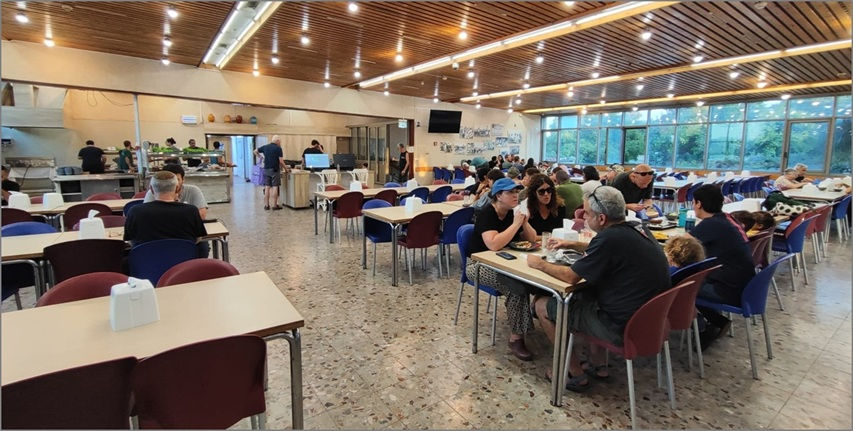
The Kibbutz transformed the relationships through which farming families operated. Work could become increasingly specialized; risks and resources could be shared; knowledge could accumulate across people rather than remain within one household; and machinery, land, infrastructure, education, decision-making, and other functions could be coordinated across the community. At the same time, the Kibbutz repeatedly brought people together through ordinary daily life, not only at work or in formal assemblies, but also over meals in the dining room, through community committees, children's education and care, cultural and leisure activities, the swimming pool, and the shared management of community life. I still remember what we called Shabbat Minhah, or "Saturday Offering," on summer Saturdays of my childhood, when everyone gathered on one of the large central lawns and ice cream was served. As children, we could hardly wait for it, but only now do I realize that such ordinary rituals also kept bringing together people whose work and responsibilities were becoming increasingly differentiated.
What looked like social life was also part of the community's organizational infrastructure, because these repeated encounters helped circulate information, strengthen familiarity and trust, reinforce shared identity, and maintain Integration across increasingly differentiated roles. This does not mean that communal children's sleeping, the dining room, the swimming pool, Shabbat Minhah, or any other particular Kibbutz practice was itself essential; rather, each was one possible mechanism through which deeper structural functions were supported. When one of these practices disappeared, the important question was therefore not simply whether the old form had survived, but whether the Capability it had helped create was still being produced in another way.
This distinction mattered because Kibbutz members themselves were not always sure what had to be preserved and what could change without weakening the community. When children stopped sleeping communally, or other familiar institutions weakened or disappeared, some saw this as evidence that the Kibbutz itself was coming to an end. Yet our investigation suggests resolving this dilemma by asking a different question: beyond their obvious purpose, what did those practices actually make possible, and can those functions continue in other ways? Integration, trust, repeated interaction, shared Direction, and accumulated relationships may survive even when the familiar form disappears. The opposite is also possible: the form may remain while the function it once supported gradually disappears.
That lesson extends far beyond the Kibbutz. An organization does not need a communal dining room, shared childcare, or a central lawn, but it does need ways for differentiated people and roles to remain sufficiently integrated over time. Different organizations may achieve that Integration in very different ways, so the task is not to copy the visible features of a successful model but to understand what those features made possible and to find other ways to produce the same underlying Capability.
This distinction also clarifies what we mean by a Capability space. A Structure does not have one fixed performance ceiling; by organizing people, roles, and relationships in particular ways, it makes some collective capabilities easier to develop and others more difficult. That space can also change as learning, technology, accumulated knowledge, new forms of Integration, and internal evolution expand what the Structure can do, so its boundaries are neither fixed nor directly visible. The Kibbutz therefore suggests a more useful question than where a structural ceiling lies: which capabilities can emerge by improving or evolving the existing arrangement, and which may require relationships that the current Structure does not yet provide?
Prosperity, in this view, did not emerge because ordinary people became extraordinary, but because they became part of an organization capable of doing extraordinary things collectively. If this interpretation is even partly correct, it changes the questions we should ask about one of the world's most persistent human challenges. When smallholder farmers remain poor despite years of improved seeds, technologies, training, finance, and development efforts, perhaps the question should not always be how to make each farmer more capable. Some of the capabilities required for prosperity, such as specialization, risk sharing, market access, coordination, and the accumulation of knowledge, may depend on a larger organized whole that does not yet exist. The uncomfortable possibility is that we may spend years improving the components while leaving largely untouched the relationships through which those components could become capable of more together.
The danger, then, is that from within a Structure we rarely know how far it can still evolve or what it may ultimately become capable of. A farmer may spend a lifetime improving the family farm; a company may become more efficient and technologically stronger; and an entire industry may continue optimizing the model that made it successful, while the Capability now required becomes increasingly difficult to develop through the relationships already in place. The hardest question is therefore not whether improvement can continue, but whether continuing to improve the Structure we have can still take us toward the Capability we need.
What Next?
The previous column warned that a system can become more efficient while weakening something the whole still needs. This column took the next step by asking whether the Structure we already have can continue developing the Capability our future requires. Yet even when Direction helps clarify what that Capability is, one uncertainty remains: does the gap reflect unrealized potential within the existing Structure, or does the required Capability depend on relationships the current Structure does not yet provide?
That uncertainty creates the risk of misdiagnosis. If we mistake an execution problem for a structural one, we may dismantle relationships, routines, trust, knowledge, and capabilities that took years to build. Conversely, if we mistake a structural problem for an execution problem, we may spend years improving performance without getting any closer to the Capability we need. The danger, therefore, is not only failing to improve but also improving what cannot solve the problem or changing what should have been preserved.
The consequences are deeply human because genuine effort and improvement may still fail to produce the future we seek. A smallholder may become a better farmer and remain poor, while a company may become more efficient, better managed, and technologically stronger yet still be less suited to a changing world. In both cases, the problem may lie not in effort or competence, but in whether the relationships and forms of Integration through which people are organized can support the Capability now required.
The challenge, then, is not to choose between improvement and structural change as competing approaches, because different situations require different responses. Better execution may be enough; the existing Structure may be able to evolve and extend what it can do; or the Capability required by Direction may depend on relationships sufficiently different to require more fundamental reorganization. The difficulty is knowing which situation we face before the consequences make the answer obvious.
Our investigation has therefore progressed through three connected questions. We began by asking whether greater efficiency truly improves the whole, then whether the Structure we already have can continue to develop toward the Capability we need. We now face the next question: how can we tell whether we have failed to realize the potential of the existing Structure, or whether the required Capability depends on relationships that the present Structure does not provide? The issue is no longer simply what to improve, but what kind of problem we are facing.
That question becomes especially difficult when the organization is not failing but succeeding. It may be competent, well managed, technologically advanced, and still improving, yet the very strengths that created its success make developing another Capability increasingly difficult. What happens when the Structure that brought us this far is still working but may no longer be enough to take us where we now need to go? That is where our investigation goes next.
=-=-=-=-=-=-=-=-=-=-=-==-=-=
* I strive to stay true to the facts and the reality they reveal. If you find an error or see a need for clarification, your insights are welcome.
See you soon,
Nimrod

Dr. Nimrod Israely writes on the structural foundations of prosperity and human systems, and is the CEO and Founder of Dream Valley and Biofeed.
P.S. Have the resources and motivation, but still stuck? I help leadership teams identify what is holding them back and decide what must change to move forward.
P.P.S. Previous column: “The Efficiency Dilemma”


Comments