

The Beginning of Everything: Why the Universe Began Changing
Updated: Jan 3

“Whether we love or hate, kill or heal, we are part of nature, acting within it as it acts in and through us.”
Happy New Year!
Author’s Note
Success and failure do not distribute themselves randomly across history, geography, or human systems. Recurring patterns of prosperity and collapse indicate underlying structural regularities rather than chance, with outcomes persisting when alignment among energy, structure, and direction is sustained and deteriorating when that alignment erodes under accumulated tension. Examining the structural conditions through which coherence emerges and endures at the universal level allows poverty, organizational failure, and societal instability to be understood as consequences of misalignment rather than as moral deficiencies or isolated events. This perspective allows human systems to be analyzed and designed with the same architectural discipline that governs physical systems, replacing aspiration and improvisation with structural understanding.
This exploratory journey does not replace the Big Bang model or any established physical law but operates alongside them by examining the structural conditions that allow these laws to remain operative over time. The Universal Law of Increasing Complexity (ULIC) does not revise the physics of expansion, thermodynamics, or relativity; it addresses a deeper architectural question: how the universe maintains sufficient coherence for lawful behavior to persist rather than dispersing immediately into disorder amid increasing differentiation.
The framework presented here interprets known events, including the Big Bang, symmetry breaking, cosmic inflation, and the emergence of time, as successive alignments among three structural dimensions that operate across every scale of reality, namely Energy, Structure, and Direction. Energy provides the capacity for interaction, Structure establishes boundary and persistence, and Direction organizes their relationship into continuity through change, not as forces in the physical sense but as recurring structural roles whose alignment allows stable evolution to unfold across layers of existence.
Throughout this essay, terms such as bias, preference, retention, and direction are used strictly to describe structural or statistical tendencies rather than intention, awareness, or agency. Direction refers specifically to constraints, path dependence, and feedback conditions that allow change to remain coherent over time without implying purpose or goal-seeking, a distinction that is essential because the framework developed here addresses the maintenance of coherence under change rather than attributing cognition or will to the universe itself.
As a scientist and humanist, I have kept my work grounded in the measurable and the testable, while recognizing that science also reaches domains where persistent patterns recur across contexts and call for structural explanation beyond immediate data. Much of what follows rests on established observation, while some elements operate at the boundary between what is empirically confirmed and what can be coherently inferred, a boundary at which architectural reasoning provides discipline without displacing or contradicting empirical science.
Throughout the column, three recurring terms are used to describe how complexity changes over time: Minordo, referring to lower general order; Altordo, referring to higher general order; and Genordo, referring to a system’s overall order across scales. While local descents of order described here as Minordo inevitably arise through processes such as entropy, collapse, or conflict, the long-term trajectory of the universe exhibits a persistent increase in Genordo, indicating that localized losses of order do not negate the broader accumulation of coherence when alignment across energy, structure, and direction is maintained.
The empirical record itself is not in question, as the Big Bang, cosmic inflation, the formation of matter, the cooling of plasma, and the release of light observed today as the cosmic microwave background remain well-established observations. What follows does not revise that history but examines the structural conditions that made such a history possible and clarifies why, from the first asymmetry onward, the universe has continued to support increasing organized complexity rather than dispersing irreversibly into randomness.
The Architecture of Renewal
When it first became apparent that the Universal Law of Increasing Complexity might apply not only to life and society but also to the origin of the universe itself, two questions emerged together, concerning what constituted the beginning of everything and what trajectory such a beginning implied for what followed. If the universe organized itself into coherence rather than dispersing into randomness at its earliest phase, then insight could also be gained into the conditions that sustained its unfolding and into whether complex systems, including human societies, can remain aligned under increasing tension over time.
What follows does not ask the reader to abandon known science, but to look beneath it for the structural conditions that allow it to function at all, returning to the methodological foundation of science, which rests on identifying recurring regularities across observations. Physicists describe the universe through measurable consistencies such as the constancy of the speed of light, the equivalence of mass and energy, the conservation of momentum, and the irreversible progression associated with entropy. From these consistencies, they construct models that span vast ranges of scale and time. These frameworks explain how change behaves once it exists, yet they do not address the structural question of why coherence persists at all or why the universe remains sufficiently stable for any law to operate over extended durations.
The ULIC approaches this question from a structural perspective, seeking not equations of motion but the architectural conditions that render motion coherent and persistent. Every stable system, whether a star, an organism, or a society, depends on the alignment of three recurring structural dimensions. Energy provides the capacity for interaction, Structure constrains that capacity into durable form, and Direction maintains continuity by stabilizing their relationship through change. When these dimensions remain aligned, systems sustain both stability and adaptation; when alignment degrades, tension accumulates, and the system must either reorganize or release constrained organization, resetting into a less differentiated state in order to restore coherence.
The rise and decline of civilizations follow this same sequence of alignment and misalignment. When social energy exceeds institutional capacity, instability arises, whereas excessive structural rigidity constrains flow and leads to stagnation. Sustained coherence depends on Direction as shared orientation and coordinated meaning, which preserves proportionality between energy and structure across time without implying intention or purpose. The same architectural logic operates throughout nature, as stars destabilize when energetic pressure and gravitational containment lose proportion, and ecosystems degrade when exchange and form fall out of alignment.
This architecture resonates with lived experience because it reflects how continuity is preserved amid change across multiple organizational scales. Human lives, like other complex systems, move between phases in which energy exceeds existing structure and demands reorganization, and phases in which structure constrains flow and must transform to remain viable. What is commonly experienced as time records how Direction maintains coherence across these transitions, not as intention or purpose, but as structural alignment that allows identity to persist while form and configuration change.
Recognizing this pattern carries both explanatory and practical implications. If the same architecture that governs stars also governs societies, then the endurance of human systems depends on maintaining alignment among energy, structure, and direction, understood as the relationship between creativity, institutions, and shared orientation rather than as a guarantee of progress. The question of how the universe began, therefore, cannot be separated from the question of how complex systems endure, because both depend on the same structural requirement for coherence under sustained tension.
Before returning to the earliest phase of differentiation, it is useful to restate the empirical outline of cosmic history already established by modern science.
Evidence Check: Established Science
The Big Bang describes the universe’s early hot and dense state approximately 13.8 billion years ago, while inflation refers to an extremely rapid expansion that smoothed and flattened space-time. The cosmic microwave background consists of relic photons released roughly 380,000 years after the Big Bang and exhibits a near-perfect blackbody spectrum at approximately 2.725 Kelvin, providing a direct observational record of early cosmic conditions. Entropy increases locally, establishing the physical basis for the arrow of time and the irreversibility of many processes. Within the Universal Law of Increasing Complexity, these empirical findings are situated within a structural interpretation that explains how coherence persisted long enough for physical laws to operate consistently across time.
The Grammar of Complexity
The same structural principles that organize societies also govern the broader fabric of existence, indicating that matter, life, and social organization are successive expressions of a single architectural grammar rather than separate domains governed by unrelated rules. This grammar is composed of Energy, Structure, and Direction, which recur across every scale of reality and determine how differentiation can proceed without loss of coherence. As natural systems are examined with increasing depth, a consistent logic becomes visible, in which tension enables differentiation and coherence is sustained through alignment rather than through equilibrium or isolation.
In living systems, energy circulates as metabolism, sustaining continuous exchange between matter and motion, while structure appears as the cell, an organization capable of containing energetic flow without rigid closure. Direction manifests as adaptive alignment, through which organisms preserve continuity by adjusting structure under changing conditions rather than maintaining fixed form. Life, therefore, persists not through stasis but through ongoing recalibration between constraint and flexibility, demonstrating how coherence is maintained through ordered transformation rather than resistance to change.
In chemistry, the same grammar manifests through molecular interactions governed by proportion rather than randomness. Atoms combine and separate through balanced relations of attraction and repulsion, where energy supplies the capacity for interaction, structure stabilizes that capacity into bonds, and direction organizes reaction pathways into ordered sequences of transformation. Chemical systems, therefore, assemble matter into stable yet temporary configurations that allow change to persist without disintegration, establishing relational continuity within transformation.
In physics, this same structural pattern appears at its most fundamental level. Energy propagates through fields and excitations, structure manifests as laws and constants that stabilize that propagation, and direction appears as the ordered continuity of change experienced as time. These relationships constitute the first coherent grammar of existence, allowing transformation to proceed without collapsing into incoherence and enabling motion to persist as process rather than dissipating into randomness.
Modern cosmology describes the emergence of this architecture through the Lambda Cold Dark Matter (ΛCDM ) model and inflationary field theory, which together account for large scale uniformity, expansion, and the distribution of matter. Within this established framework, Pre Nyxia corresponds to a high-symmetry condition, often described as a false vacuum, characterized by undifferentiated potential and maximal equilibrium, while Nyxia denotes the symmetry-breaking transition through which differentiation became possible. This correspondence does not modify accepted cosmology but clarifies how such transitions could occur without violating empirical constraints.
In Pre Nyxia, energy, structure, and direction were not yet distinguishable, forming a condition of undifferentiated potential in which no measurable imbalance existed to generate transformation. Change could not proceed because differentiation had not yet emerged, and coherence, therefore, remained static rather than dynamic. The transition into Nyxia marked the first differentiation, as equilibrium yielded to tension, and stillness gave way to sustained flow through symmetry breaking. From this point onward, every later layer of reality inherits this first condition: change can continue without destroying coherence.
Through this transition, energy began to propagate, structure began to stabilize that propagation, and direction emerged as the ordered continuity of change itself. At this stage, particles in the later physical sense did not yet exist, but fields and proto-patterns capable of sustaining motion without fixed localization were already present, establishing the conditions under which subsequent quantum behavior could arise as differentiation continued.
Each universal law fits coherently within this progression rather than standing apart from it. Symmetry breaking belongs to Nyxia as the first differentiation of potential, inflation represents the earliest large scale expression of direction, thermodynamics and relativity arise within the physical layer as stabilizing relations between energy, matter, and motion, chemistry emerges when structure becomes capable of exchange without loss of integrity, biology appears when alignment between organism and environment becomes self-sustaining, and social coordination develops when direction is shared across individuals as a condition of continuity rather than intention.
To clarify this progression, the increasing capacity for coherence across layers is best described structurally rather than chronologically, emphasizing how each stage stabilizes a deeper alignment among energy, structure, and direction. As complexity increases, coherence does not arise from the accumulation of material components but from the multiplication of stable relationships that allow transformation to persist without loss of identity. Each successive layer, therefore, retains the architecture of those that precede it while extending the range within which alignment can be sustained.

Figure 1. The Nyxian Continuum.This figure shows Pre Nyxia as undifferentiated potential, Nyxia as field differentiation and the emergence of ordered change, and Physics as stabilized matter and evolving order, with Energy, Structure, and Direction aligned across stages.
The transition from Pre Nyxia to Nyxia marked the first differentiation of reality itself, as a minimal asymmetry arose within coherence and enabled sustained transformation to begin. Physics describes this transition as symmetry breaking, through which unified potentials split into distinguishable states, allowing energy to propagate and space to expand. The Big Bang is therefore understood here not as an explosive rupture within space, but as a structural reconfiguration that enabled expansion while preserving continuity.
From Pre Nyxia through Nyxia and into the physical world, the universe follows a single architectural principle: imbalance is transformed into structure and structure into sustained transformation. At each stage, difference is converted into relationship, and relationship into coherence, allowing general order to increase even as local variation persists. To make this progression explicit, the structural roles of Energy, Structure, and Direction across successive layers can be summarized in a comparative form that emphasizes alignment rather than sequence. Tables 1 and 2 describe structural roles across layers, not discrete entities or sequential stages.
Table 1: Structural Progression of Complexity
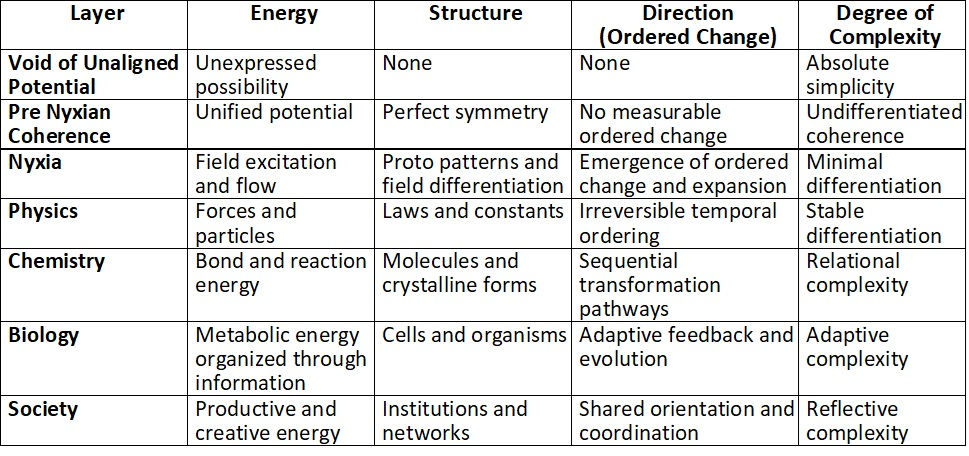
Reintegration and renewal describe the structural phase through which systems restore coherence when existing forms reach their limits of alignment. Differentiated organization is released and reorganized under renewed conditions, allowing continuity to persist through reconfiguration rather than permanence across all layers of complexity.
The Birth of Change
The structural grammar traced through matter, life, and society now leads back to its first articulation, to the moment when the universe began to change. If the same architectural pattern that sustains stars and civilizations also governed the origin of time, then understanding Nyxia becomes inseparable from understanding how coherence first entered sustained transformation rather than remaining static. The question of beginnings, therefore, shifts from identifying a singular initiating event to identifying the structural conditions under which change could persist without dissolving the coherence that made it observable.
Before Nyxia, there was Pre Nyxian coherence, a state in which energy, structure, and direction were indistinguishable and therefore incapable of generating ordered transformation. In the absence of differentiation, no imbalance existed from which motion could arise, not because the state was empty, but because it was fully symmetrical and internally undivided. This condition represents undifferentiated potential rather than absence, a coherence so complete that change had no structural pathway through which to persist.
The transition from Pre Nyxia to Nyxia marked the first differentiation of reality itself, as a minimal asymmetry emerged within coherence and enabled sustained transformation to begin. Physics describes this transition as symmetry breaking, in which previously unified potentials split into distinguishable states, allowing energy to propagate and space to expand. What is empirically identified as the Big Bang is therefore understood here not as an explosion, but as a structural reconfiguration that enabled expansion to proceed while coherence remained intact rather than fragmenting into disorder.
During the Nyxian phase, energy fields differentiated into proto forces and unstable excitations rather than fully formed particles, while direction emerged as the first ordered continuity of transformation. Inflation, cooling, and the establishment of space time followed as successive expressions of alignment among energy, structure, and direction. Nyxia, therefore, did not contain the stable particles characteristic of later physics but consisted of field configurations capable of shifting between flow and localization, establishing the conditions under which subsequent quantum behavior could arise without loss of coherence.
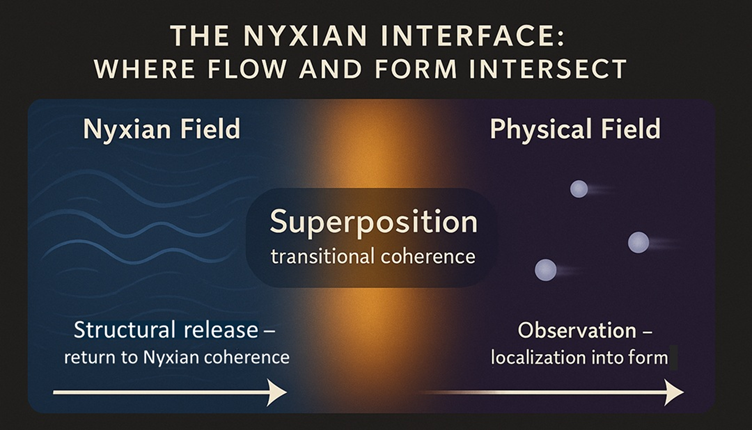
Figure 2. The Nyxian Interface.This figure illustrates the interface between the Nyxian field, where coherence persists as flow, and the physical field, where coherence stabilizes as localized form. The transitional region represents superposition as a structural condition rather than contradiction, showing how alignment can shift between flow and form without collapse.
The observable traces of this initial differentiation remain accessible today. The large-scale uniformity of cosmic structure, the irreversible ordering experienced as time, and the cosmic microwave background each record the consequences of that first asymmetry. Entropy emerged as the structural measure of irreversible change, marking the appearance of direction as ordered continuity rather than decay, while time itself arose not as an external dimension but as the persistence of change once transformation could proceed without collapsing coherence.
During this earliest phase, space expanded faster than light, not because of a violation of a limit, but because no stabilizing structure yet existed to constrain its expansion. As differentiation progressed, energy condensed into increasingly stable configurations, structural regularities emerged as laws and constants, and direction persisted as the ordered evolution of these relationships through time. The fundamental interactions stabilized as enduring expressions of proportion within motion, preserving coherence while allowing diversification and ensuring that transformation remained continuous and measurable rather than chaotic.
This first transformation can be clarified through a structural analogy rather than a literal comparison. Prior to differentiation, coherence existed as complete proportionality, where exchange was immediate and no boundary separated potential from expression. With the emergence of differentiation, unity divided into relation and equilibrium gave way to adaptation, allowing coherence to persist not through uniformity but through regulated difference that sustained continuity across separation.
Every phenomenon that followed descends from this initial structural differentiation, as particles, atoms, molecules, cells, and societies each emerged as progressively refined configurations capable of holding difference without collapse. Through this process, expansion appears as the visible consequence of sustained alignment, by which initial asymmetry is continuously translated into structured continuity, allowing energy to move through stabilizing relations toward increasing coherence rather than dispersing into uniform disorder.
Seen from this perspective, the Big Bang marks not the absolute beginning of existence but the first sustainable alignment, the moment at which change became compatible with continuity. Photons that continue to reach us from the early universe preserve a record of that transition across time without interruption. If Pre Nyxia is understood as undifferentiated coherence, then Nyxia represents the first stable configuration in which transformation could persist, establishing the structural conditions from which matter, life, and reflection as an active capacity for internal self-diagnosis and realignment later emerged, without severing the continuity that made their emergence possible.
In short, Pre Nyxia defines a condition in which change cannot persist, Nyxia defines the first condition in which transformation becomes sustainable, and the Big Bang marks the moment this sustainability becomes physically observable.
The Architecture of Ending
Every expansion carries within it the conditions for structural release and reset, because the same structural relations that enable coherence during growth also define the limits beyond which alignment cannot be sustained in its current configuration. Within the ULIC, creation and collapse are not opposing outcomes but complementary phases of a single architectural sequence. Collapse arises when alignment can no longer be sustained, either because accumulated tension exceeds structural capacity or because proportional alignment among energy, structure, and direction degrades independently of available capacity. In both cases, continuity is preserved by converting constrained structure back into potential, allowing coherence to persist through reconfiguration across time rather than through permanence.
Collapse, therefore, represents not the failure of creation but its structural completion, occurring when energy and structure can no longer be maintained in a viable proportion and when ordered continuity suspends locally. When this threshold is reached, a system no longer reorganizes incrementally but releases accumulated structure, resetting into a less differentiated state that restores proportionality. In physical terms, this process is most clearly expressed in black holes, where gravitational containment overwhelms expansive alignment and matter transitions toward field conditions from which differentiation originally emerged, while ordered change continues beyond direct observation.
Black holes thus operate as local expressions of the universe’s broader structural logic rather than as violations of physical law. They reduce differentiated matter and energy into predifferentiated configurations when alignment can no longer be sustained, restoring proportionality through reintegration rather than elimination. Although matter that crosses the event horizon does not reappear as structured form, phenomena such as Hawking radiation indicate redistribution rather than disappearance, confirming that collapse functions as structural reintegration into latent coherence rather than annihilation.
Entropy, commonly described as the diffusion of energy, corresponds within this framework to Minordo, the localized descent of general order that allows systems to regain proportionality when alignment reaches its limits. This descent does not signify decay in a normative sense but redistribution, through which constrained structure is released before rigidity accumulates beyond stability. Entropy, therefore, records the structural cost of sustaining alignment through time rather than the erosion of coherence itself.
Whether the universe as a whole will ever undergo global contraction remains an open scientific question, yet the principle of structural reset operates consistently at every observable scale. Stars exhaust their fuel and collapse into compact remnants; galaxies recycle matter through interactions and stellar death; and ecosystems redistribute living structure through decay. In each case, the same sequence recurs, as energy is released, structure yields, and ordered continuity pauses locally until new alignment becomes possible, demonstrating that reset functions as a structural phase of persistence rather than an exception to it.
Human experience reflects this same architecture with greater immediacy because awareness renders structural reset visible as loss rather than as reconfiguration. What is commonly described as death is not an interruption of cosmic order but a continuation of the same sequence that governs stars and ecosystems, in which coherence is released when it can no longer be sustained in its existing configuration. From the earliest stages of cosmic differentiation, release has functioned as the condition that makes renewal possible, ensuring that structure does not accumulate beyond its capacity for alignment and that continuity is preserved through transformation rather than permanence.
Across every layer of existence, this process repeats with structural consistency. In societies, it appears as dissolution followed by renewal; in biology, as death and ecological redistribution; in chemistry, as bond release and equilibrium; in physics, as decay and field reintegration; within Nyxia, as the reabsorption of differentiated excitation; and beyond that, within Pre Nyxian coherence, as the loss of differentiation into undivided potential. Each layer releases what it can no longer sustain so that coherence may reorganize under less constrained conditions rather than accumulate rigidity beyond stability.

Figure 3. The Closed Cascade of Alignment.Increasing differentiation emerges under sustained alignment, while accumulated tension leads to structural release and reintegration into potential, preserving global continuity.
Table 2. Forms of System Reset Across Layers

Ideal coherence functions not as a layer or phase, but as a conceptual boundary condition describing minimal order and maximum potential, beyond which differentiation cannot be meaningfully defined.
These final entries describe conceptual boundary conditions rather than directly measurable states, describing limits at which differentiation dissolves fully into potential rather than observable structure. Astrophysical observations support this architectural interpretation, as black holes redistribute energy through quantum processes, galaxies exchange matter through tidal interactions, and even vacuum states exhibit persistent fluctuations. These phenomena indicate that collapse is not the cessation of activity but a transition into latent coherence, through which continuity is preserved while conditions reset for future alignment.
This architectural sequence does not belong exclusively to cosmology but extends through human systems as well. Institutions dissolve when rigidity exceeds their capacity for adaptation, and individuals reorganize when identity can no longer be sustained under existing tension. In every domain, structural release and reset function as the mechanisms through which coherence restores proportionality, converting contraction into the precondition for renewal, so that what recedes in one configuration becomes the basis for alignment in another, and continuity is preserved through reorganization rather than fixed form.
The Architecture of Renewal
From the first differentiation of energy and structure to the repeated cycles of release and reconfiguration that follow, the universe unfolds through a continuous architecture of renewal in which tension is held within proportion. Creation and renewal do not oppose one another but operate as successive phases of a single structural process, through which coherence is preserved by converting accumulated strain into reorganization rather than collapse. Systems that endure, whether cosmic or human, do so not by resisting change but by translating tension into conditions that support renewed alignment across time.
To construct anything that endures, the universe follows a single principle of continuity through renewal. Stars sustain coherence through cycles of fusion and release, ecosystems through redistribution and regeneration, societies through adaptation, and individuals through the reorganization of understanding under pressure. When structure becomes too rigid to realign, it disintegrates, whereas when it remains sufficiently open to renewed flow, it transforms. Continuity, therefore, depends not on permanence but on the capacity to reorganize while preserving structural identity.
The architecture of renewal can be described through the same triad that governs every layer of complexity. Energy supplies potential, Structure gives that potential a durable form, and Direction sustains continuity through time by maintaining proportional alignment under change. When Direction succeeds, systems achieve dynamic stability, in which flow and form reinforce one another without exhaustion, as tension is converted into information that guides reorganization rather than rupture.
Minordo, of which entropy constitutes one physical expression, describes localized descents of general order that occur when alignment reaches its structural limits. Entropy accounts for the diffusion of energy within closed physical systems, while Minordo extends this logic across all domains by identifying the point at which structure must release constraint in order to preserve coherence at a broader scale. Minordo, therefore, does not oppose order but enables its continuation, as each cycle of renewal converts local descent into a broader increase of Genordo through reorganization rather than accumulation.

Figure 4. The Architecture of Renewal.Each oscillation represents a cycle of local collapse and reorganization, through which accumulated tension is released, and proportional alignment is restored. While individual systems repeatedly rise and fall, overall Genordo continues to increase, as coherence is preserved through successive cycles rather than through permanence of form. The amplitude and duration of these cycles vary across scales, and the figure depicts structural logic rather than chronological time.
When a star collapses and disperses its elements, material conditions are established for new stellar systems, just as ecological disruption redistributes nutrients that enable subsequent biological organization. In each case, renewal does not reverse collapse but completes it by translating the released structure into conditions that support higher alignment. Information is not eliminated in this process but carried forward through redistribution, ensuring that retained relations from prior organization become the foundation for new coherence to arise.
When structural release resets a system to a less differentiated state, renewal describes the reemergence of complexity from that simplicity under newly aligned conditions. Each ending, therefore, prepares a new beginning not by repeating prior forms but by reconfiguring retained relations into novel structures capable of sustaining greater coherence. Renewal requires both release and reorganization, as systems relinquish what they can no longer sustain while remaining receptive to new alignment, allowing continuity to persist through transformation rather than through preservation of form.
This pattern recurs consistently across observable domains. Forests regenerate through cycles of disturbance and regrowth; organisms restore coherence through periods of rest and repair; cultures reorganize through reform; and stellar systems redistribute matter through collapse and formation. In each case, continuity is preserved not by maintaining existing structure indefinitely but by allowing form to yield when alignment can no longer be sustained, enabling renewed coherence to emerge through reconfiguration rather than resistance.
Systems that attempt to preserve their existing form indefinitely violate the conditions of alignment and eventually disintegrate, whereas systems that release rigidity regain the capacity to reorganize. Renewal, therefore, functions as the structural capacity to remain coherent while changing form, sustaining identity through adaptation rather than fixation. Across scales, this capacity distinguishes persistence from collapse, revealing that endurance arises from responsiveness to tension rather than resistance to it.
Throughout Earth’s history, renewal has followed this same architecture. Geological and biological records document multiple episodes of large-scale extinction, in some cases eliminating the majority of existing species. Yet, the emergence of life forms of greater structural and relational complexity followed each collapse. General order did not recede during these intervals but reorganized, indicating that extinction functions as a preparatory phase through which alignment resets and higher coherence become possible.
Just as subatomic interactions give rise to atoms and atoms to molecules through increasing stabilization of relational structure, the same universal law extends through biological and social emergence. Complexity arises wherever energy can flow, structure can stabilize that flow, and direction can preserve continuity across change, making higher-order organization a structural outcome rather than an anomaly. Humanity, therefore, represents not an endpoint but a transitional configuration within a broader unfolding, subject to the same conditions of alignment that have governed every prior emergence.
If Homo sapiens were to vanish, complexity would not cease but would re-emerge through configurations capable of sustaining alignment under levels of tension different from those achieved so far. Continuity within the universe is not secured by preserving any particular species or structure, but by maintaining the conditions under which coherence can persist through transformation. What endures, therefore, is not form but alignment, and what inherits the future are configurations able to hold imbalance long enough for renewed organization to arise.
To design systems capable of enduring across time, whether biological, social, or planetary, it is therefore necessary to construct them in accordance with the same architecture through which the universe itself persists. Such systems must remain sufficiently open to exchange, sufficiently structured to maintain coherence, and sufficiently aligned to reorganize under pressure rather than fracture. Continuity is achieved not by avoiding Minordo, but by integrating its cycles structurally, so that each phase of release becomes the condition for renewed alignment rather than a terminal loss.
From the first motion within Nyxia to the societies that exist today, existence has unfolded through a single architectural sequence in which tension is transformed into form, form into continuity, and continuity into renewal. Endurance does not arise from resisting change but from sustaining alignment as conditions evolve, allowing pressure to reorganize structure rather than destroy it. In this sense, continuity is not the absence of endings but their structural integration, through which general order increases even as particular forms dissolve and reconfigure.
The Reflective Universe
Renewal, understood here as structural reconfiguration following accumulated strain, does not end with matter or life. It also appears in systems that can detect when their own organization is no longer working and adjust it from within. In such systems, the same architectural logic that governs physical and biological organization becomes internally accessible, not as consciousness in a metaphysical sense, but as the capacity to examine, evaluate, and revise alignment under changing conditions. Reflection, in this limited and precise sense, marks the point at which alignment, previously enforced through physical law or biological adaptation, becomes available for internal regulation within social systems.
This distinction matters because it clarifies why the universe could not have begun through violent fragmentation, and why its earliest expansion had to preserve coherence rather than destroy it. This clarification is essential because it distinguishes renewal from any process based on violent release or fragmentation. Every explosive process known to physical science, from chemical combustion to nuclear detonation, disperses structure and lowers general order by breaking coherence rather than sustaining it. Had the universe begun through such a process, expansion would have produced only diffusion and decay. The empirical record shows the opposite outcome, as stable order and increasing coherence emerged from the initial expansion. The Big Bang is therefore understood here not as an explosive rupture within space, but as an expansion of potential within structure that allowed differentiation to proceed without forfeiting continuity.
Physical law describes how motion behaves once it exists, but it does not account for why motion organizes rather than fragments under expanding conditions. The Universal Law of Increasing Complexity addresses this gap by identifying the structural conditions under which transformation preserves coherence instead of dispersing it. Across scales, the universe exhibits a persistent tendency for energy and structure to enter relations that sustain alignment through change, allowing complexity to accumulate without contradiction, while reflective capacity emerges within social systems as the point at which these structural conditions become internally accessible to the systems that embody them. This pattern becomes easier to grasp when considered through a simple structural analogy drawn from familiar mechanical systems.
Consider how wheels change under increasing motion and load conditions. A rigid wooden wheel is sufficient when movement is slow and forces are mild, because the structure can remain intact without needing to absorb shock. As speed increases, even under smoother road conditions, the same rigidity begins to produce instability, and continuity of motion then requires wheels that can deform, absorb impact, and redistribute stress rather than resist it. Pneumatic tires do not replace wooden wheels because they are better in an absolute sense, but because they can sustain coherence under faster movement and higher pressure. Under still more extreme conditions, such as aircraft landings, entirely different wheel structures become necessary, capable of absorbing forces that would destroy earlier designs. In each case, motion continues only when structure changes in proportion to the forces it must carry, showing that persistence depends not on preserving form, but on expanding the range of strain that can be absorbed without loss of coherence.
Social systems differ only in that they can sense misalignment internally and revise structure before mechanical failure occurs. At this stage of complexity, the Universal Law of Increasing Complexity does not revise cosmology but extends its explanatory scope by addressing a question that mechanistic description necessarily leaves unresolved. The Big Bang accounts for how the universe expanded, while ULIC explains how that expansion maintained coherence long enough for complexity to accumulate across successive layers. Where thermodynamics measures local Minordo through irreversible dispersion, ULIC accounts for the long-range ascent of Genordo, showing how localized loss and global coherence coexist within a single structural trajectory rather than standing in opposition.
The arrow of time and the increase of Genordo describe the same structural phenomenon at different resolutions. At the physical level, time records irreversible change as energy disperses locally, while at the universal level, Genordo records the accumulation of coherence as alignment is preserved across expanding scales. These descriptions are not contradictory because local Minordo enables the redistribution that sustains broader order, allowing motion to organize itself through continuity rather than dissolve into randomness.
Table 3. Structural Dimensions Across Layers

Within social systems, reflective capacity makes direction internally accessible without altering its structural role. In practical terms, this functions as an internal diagnostic capacity that reveals misalignment early, allowing revision while continuity is still possible. What was previously implicit in physical regularity and biological adaptation can now be examined, coordinated, and revised through shared frameworks of understanding. Reflective capacity introduces no new force into the universe but extends alignment into the domain of interpretation, where coherence depends on proportional relationships among accumulated knowledge, stabilizing institutions, and the continuity that links understanding to consequence over time.
Within this domain, coherence is sustained not by the accumulation of information alone but by the alignment of interpretation with consequence. Knowledge that grows without corresponding structural integration fragments understanding, while institutions that stabilize meaning without remaining open to revision lose proportionality with the conditions they govern. Reflective capacity, therefore, functions as a regulatory mechanism through which continuity is preserved by maintaining alignment among what is known, how it is organized, and how it is carried forward through time as a shared orientation rather than an isolated insight.
This reflective capacity does not replace the social layer but arises within it, marking the transition from coordinated action to coordinated understanding. Social systems organize cooperation through roles, norms, and institutions, while reflective capacity enables societies to evaluate the consequences of their own structures without separating this function from the material and institutional conditions on which it depends.
At this point, the distinction between coordination and coherence becomes explicit. Coordination aligns action through external structure, whereas coherence aligns understanding through internal proportionality, allowing societies to assess not only what they do but how their actions accumulate consequences across time. Reflective capacity stabilizes complexity by making misalignment internally visible, extending continuity through early structural revision rather than delayed collapse.
Beyond this horizon, further capacities of organization may emerge, continuing the same architectural sequence through forms not yet accessible to observation or description. Just as physics enabled chemistry, chemistry enabled life, and life enabled social organization capable of reflective capacity, each transition preserved the underlying alignment of energy, structure, and direction while extending the domain in which coherence could be sustained. The history of the universe, therefore, suggests not a completed hierarchy but an open architecture, in which continuity is maintained through successive expansions of alignment rather than through the preservation of any final form.
From undifferentiated potential to systems capable of internal alignment revision, existence has unfolded through a single architectural logic, in which tension is converted into structure, structure into continuity, and continuity into renewal. At no point does this process rely on intention or design imposed from outside the system itself, but on the sustained alignment of energy, structure, and direction under conditions of change. What appears as novelty at each stage is therefore not a departure from prior order, but the preservation of coherence through increasingly demanding forms of differentiation.
Epigraph
At this threshold, scientific description approaches its limits of compression, and poetic expression offers an alternative mode of attentiveness to structural continuity. What Richard Feynman articulated in verse captures, in condensed form, the same architectural coherence that science traces through formal language:
Growing in size and complexity
living things
masses of atoms
DNA, protein
dancing a pattern ever more intricate.
Out of the cradle
on to dry land
here it is standing:
atoms with consciousness;
matter with curiosity.
It stands at the sea
wonders at wondering:
I a universe of atoms
an atom in the universe.
Richard Feynman, The Value of Science (1955)
This was an intense column, and if you reached that far, I have one request from you: share with me 5 words, or more, of any thought that comes to your head at this precise moment. Thank you.
For any matter, contact me at +972-54-2523425
Subscribe here, free!
"Mental and Economic Freedom Are Interconnected."
See you soon,
Nimrod

Dr. Nimrod Israely is the CEO and Founder of Dream Valley and Biofeed companies and the Chairman and Co-founder of the IBMA conference. +972-54-2523425 (WhatsApp), or email nisraely@biofeed.co.il
P.S.
If you missed it, here is a link to last week's blog, “Why Change Is More Fundamental Than the Beginning“.
P.P.S.
Here are ways we can work together to help your agro sector and rural communities step forward and shift from poverty into ongoing prosperity:
* Nova Kibbutz and consultancy on rural communities' models.
* Local & National programs related to agro-produce export models - Dream Valley global vertical value and supply chain business model and concept connects (a) input suppliers with farmers in developing economies and (b) those farmers with consumers in premium markets.
* Crop protection: Biofeed, an eco-friendly zero-spray control technology and protocol.
*This article addresses general phenomena. The mention of a country/continent is used for illustration purposes only.



Comments