

The Architecture of Time: How Structure Gives Time Its Direction
Updated: Jan 17

“Social organizations that hold the pressure of transformation are the ones through which history is written.”
We say time flies when we are busy and stands still when we are not, yet this familiar expression points to something deeper than metaphor, suggesting that time itself is inseparable from what changes and from how intensely those changes unfold. For most of history, human beings lived in a world where almost nothing changed in any meaningful way, and time therefore barely registered as an independent concern. Days repeated, seasons returned, generations mirrored one another, and the only time that truly mattered was now. In today’s world, however, where a single moment can redirect lives, economies, and societies, we are no longer asking when time passes but what time actually is.
In ancient societies, time was often divided into only three categories: yesterday, today, and tomorrow. In communities where life patterns remained stable for generations, these distinctions were sufficient because nothing of consequence changed from one moment to the next. There was no need for hours or minutes when the structure of life itself barely changed. In contrast, in an era defined by acceleration, we have invented ways to measure time in seconds and milliseconds and now live between deadlines that vanish almost as soon as they appear. As the pace of change increases, time seems to multiply, fragment, and press upon us more forcefully, even as its nature remains elusive. We sense that time behaves differently now, yet we still struggle to explain why.
The Universal Law of Increasing Complexity (ULIC) offers a new path forward, not by redefining time as physics traditionally measures it, but by explaining how time acquires direction when change is held within structure long enough to produce transformation. From this perspective, time is neither the container in which change occurs nor an empty corridor through which systems move, but the outcome of sustained pressure within form. Where structure can hold energy, contradiction, and continuity, transformation becomes possible, and time begins to take shape.
At the center of this perspective is the concept of Genordo, a term that describes the degree of structural order and functional complexity within a system. Genordo is dynamic rather than fixed, and as it rises or falls, so too does the experience and direction of time. When Genordo reaches a state of relative stability, in which structure holds but does not meaningfully transform, the system is Genostatic. When Genordo collapses, descending into fragmentation and the loss of coherent form, the system enters a state we call Minordo. When Genordo rises to a level of self-sustaining and self-transforming coherence, in which structure holds not only itself but also the tension required to evolve, the system reaches Altordo. Together, these states describe the range of structural conditions through which systems persist, stabilize, or transform, and they will later allow us to see how time becomes visible not as abstract motion but as transformation that holds.
Time Is Not What Passes, But What Changes
Unlike the speed of light or subatomic forces, time is neither a force nor a universal rhythm but a measure of structural transformation. In systems where nothing changes in any meaningful way, time effectively disappears, whereas in systems where transformation accelerates and accumulates, time appears to expand and intensify. This difference explains why we experience time so differently when we are deeply engaged versus when we are idle, not because perception shifts arbitrarily but because the amount of transformation being integrated changes. Our language reflects this intuition with remarkable accuracy, as we say that time flies, stretches, slows, or even stops, revealing an implicit understanding that time is inseparable from the pace, depth, and coherence of change.
Change alone, however, is not sufficient for time to acquire direction, because without structure to carry it forward, change dissolves into noise rather than continuity. A rock thrown into water creates ripples, yet unless there is something to contain, preserve, or register those ripples, they vanish without consequence. Time, therefore, cannot be reduced to change alone but must be understood as movement that is held, since the capacity to hold transformation determines whether time forms, expands, or fades into indifference.
Genordo captures this capacity by describing the degree to which a system can organize change into sustained direction. When Genordo rises, the system is able to hold greater pressure without fragmentation and to metabolize that pressure into increased capacity and broader possibility. When Genordo falls, the same pressure fragments structure rather than strengthening it, coherence breaks down instead of accumulating, direction collapses, and time loses its forward character, whether by stalling, dispersing, or dissolving altogether.
This is not a metaphor, but a pattern visible across all layers of reality, because time becomes meaningful only where something holds long enough to transform.
Time Is Shaped by Structures
Time is often imagined as a neutral container into which events are placed, yet this image fails to explain why time appears to stretch, compress, or lose direction altogether, depending on the system in which it unfolds. Time does not exist independently of structure, because without continuity there is no meaningful distinction between before and after, and without coherence there is no transformation that can be carried forward. What we call time emerges only where structures persist long enough to absorb change and convert it into continuity.
This relationship becomes clearer when we examine how time behaves across different structural scales. An atom is in constant motion, yet little accumulates because no structure endures long enough for transformation to matter. Molecules introduce limited coherence but retain only a shallow temporal trace. Stars hold enormous tension over long durations, allowing transformation to persist, while galaxies extend this coherence across vast scales, creating deep temporal continuity. A unicellular organism experiences time as immediate cycles, whereas a multicellular organism experiences it as development, aging, and learning, because structure carries transformation across years rather than moments. In each case, time does not change because motion increases, but because structure integrates change rather than letting it dissolve.
Living organisms introduce a new layer in the architecture of time, because biology carries memory not only through structure but through replication. In plants and animals, time is encoded implicitly within genomic sequences that preserve cycles of growth, reproduction, hierarchy, and seasonal rhythm. This biological time does not yet distinguish history from intention, but it allows transformation to accumulate across generations rather than moments. Migration patterns, mating cycles, and developmental stages all reflect structures that hold continuity long enough for change to matter, even in the absence of reflection or narrative.
Early humans initially lived within this biological regime of time, little different from other organisms whose lives unfolded through cycles rather than histories. Without external structures capable of preserving memory beyond the living body, the past did not exist as a domain distinct from the present, nor did the future carry meaning beyond immediate survival. Time, for such humans, was an ongoing event rather than a narrative, experienced but not yet registered, endured but not yet remembered.
With the emergence of self-consciousness came the awareness of mortality, and with it a new pressure that biology alone could not contain. The fear of disappearance pushed humans to create structures that could outlast the body, marking a decisive shift in the architecture of time. Handprints on cave walls, paintings, ritual objects, songs, poems, and later stories served no immediate survival function, yet they preserved identity across generations. In creating marks meant to be seen by others not yet born, humans transformed time from an experienced flow into a shared continuity, overcoming death not by avoiding it, but by embedding memory into structure.
This marked the transition from implicit time to explicit time. Biological systems carry time silently through genetic continuity, while human societies externalize time through symbols, institutions, and shared narratives. Knowledge transmission may preserve function, but stories, myths, and art preserve existence itself, allowing what was to remain present long after its physical disappearance. Through these structures, time became something humans could build, extend, and shape deliberately, rather than merely endure.
The same structural logic applies beyond the physical world. Imaginary structures, though intangible, are no less real in their effects. A startup often accumulates change at an intense pace, yet within the organization days feel ordinary and exhausting because time always feels normal inside the structure that holds it. Only when viewed from the outside does it become clear that far more transformation has accumulated in the same external time than in comparable organizations. A prosperous, well-integrated company experiences time as investable because learning compounds, decisions propagate coherently, and the future becomes increasingly differentiated from the past. A failing organization, by contrast, may feel just as busy from within, yet from the outside it appears frozen or erratic, repeating effort without progress, because transformation overwhelms structure rather than being metabolized by it.
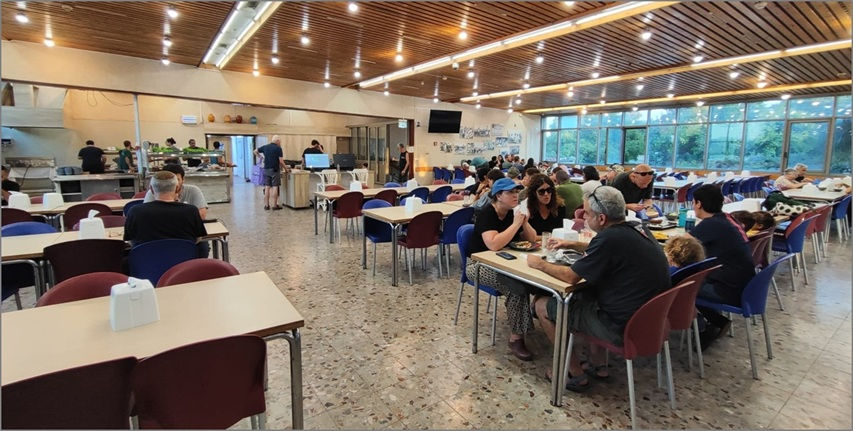
This contrast becomes even more visible at the societal level. For example, in the early Kibbutz, daily labor felt repetitive and demanding to those inside it, yet from the outside an extraordinary transformation was visible within a remarkably short historical period because the structure could hold contradiction and convert effort into collective capacity. During later periods of erosion, routines often continued unchanged from within, while observers saw stagnation, loss of direction, and a slowing of historical momentum as structural coherence declined. In both cases, clocks moved at the same rate, but time itself accumulated differently when compared across structures.
What distinguishes systems that prosper from those that collapse is therefore not how much change they experience, but how much change they can integrate without losing coherence. Structures with rising Genordo can withstand pressure without fragmenting, resolve internal contradictions, and convert transformation into future capacity, allowing time to become directional and cumulative. Structures with falling Genordo accumulate change that accelerates exhaustion rather than progress, consuming time without generating meaningful continuity. In all these cases, time does not flow faster or slower because of perception, effort, or urgency, but because structures differ in their capacity to hold transformation relative to their environment.
Complexity Is Not Opposite to Entropy; It Contains It
For more than a century, the second law of thermodynamics has shaped how time is understood in physics by establishing that entropy increases and that energy in closed systems becomes progressively less available to do work. This principle has often been interpreted to mean that time itself is driven by decay and that the arrow of time points inevitably toward disorder and equilibrium. While this description captures an important aspect of physical reality, it does not explain why complexity continues to arise alongside entropy or why many systems develop increasing coherence rather than disintegrating.
Across the universe, we observe stars forming while others collapse, life emerging while other organisms perish, and societies building institutions even as others fragment. These are not violations of thermodynamics but expressions of how energy and pressure are reorganized through structure. Complexity does not oppose entropy but contains it, because the same forces that drive dissipation also generate new forms when structure can hold transformation rather than surrender to collapse.
Within the framework of Genordo, entropy reflects one extreme tendency within a broader structural spectrum rather than an opposing principle. When coherence collapses and structural capacity is lost, systems move toward Minordo, a condition in which energy can no longer be organized into sustained transformation, and change dissolves into fragmentation. Entropy is one physical expression of this condition, but Minordo extends beyond thermodynamic disorder to describe the breakdown of structure across physical, biological, and social systems. At the other end of the spectrum lies Altordo, where structure converts internal tension into increasing capability, allowing transformation to accelerate without disintegration, while Genostatic states occupy the middle ground, holding form without meaningful evolution.
The ULIC describes how systems move along this spectrum, not by negating entropy but by explaining when and how transformation becomes directional. Time does not flow because entropy increases, but because systems shift in their capacity to hold change. When Genordo rises toward Altordo, transformation accumulates, and the future differentiates itself from the past with increasing clarity. When Genordo falls toward Minordo, continuity collapses, and time loses direction, fragmenting into disconnected moments. Entropy, therefore, appears not as the driver of time but as one expression of falling Genordo within systems that can no longer sustain coherence.
Treating time as a universal force independent of structure overlooks its source. Time becomes visible only where structure endures long enough to either rise or fall along the Genordo spectrum. What matters is not whether a system grows or decays, but whether it retains the capacity to transform in a way that leaves a trace. Where structure holds, time takes form; where it fails, time dissolves.
Bridging Relativity and Quantum
Time behaves very differently depending on the scale at which it is observed, and this difference has long stood at the center of modern physics. In Einstein’s theory of relativity, time is not fixed or absolute but bends, stretches, and slows depending on speed and gravity. Clocks run more slowly near massive objects and for observers moving at extreme velocities, revealing that time is shaped by the structure of space and the distribution of energy within it. Relativity shows us that time is not independent of form but is altered wherever structure becomes sufficiently dense.
At the quantum scale, however, time appears to lose its familiar role altogether. In equations describing particles, atoms, and wave functions, time often appears only as a parameter, and in some formulations it disappears entirely. Quantum systems evolve through probabilistic states without a clear sense of before and after, and without the accumulation of memory that characterizes time at larger scales. This has led many physicists to describe quantum mechanics as operating in a timeless or nearly timeless domain, creating a deep tension between the foundations of quantum theory and relativity.
The ULIC reframes this tension by shifting attention from equations to structure. Time does not emerge from motion alone or from energy in isolation, but from a system’s capacity to sustain transformation across continuity.
At the most fundamental level of physical reality, time does not appear as a universal feature but as a conditional one. Subatomic particles participate in interaction and motion, yet they lack internal structure capable of holding transformation across continuity, and without such structure, change does not accumulate in a way that preserves a distinction between before and after. From the particle’s own frame, the moment of its creation and the moment of its interaction are indistinguishable, not because time halts as a force, but because nothing within the particle can register transformation as history. Time at this level exists only as an external parameter imposed by observers, not as a property sustained by the system itself.
This structural perspective also clarifies why the speed of light appears as a universal limit. Where structure dissolves, the capacity to register transformation collapses with it, and where no transformation can be accumulated, time itself ceases to have meaning within the system. Nothing can meaningfully exceed this boundary, not because of an imposed cosmic speed limit, but because beyond it there is no structure capable of sustaining temporal continuity. The speed of light thus marks the structural boundary at which internal time collapses to zero, because no system can accumulate less than zero transformation, and beyond this boundary, temporal continuity cannot be sustained.
The same logic helps explain why the early expansion of the universe could proceed faster than the speed of light without contradiction. In the earliest moments, space expanded in the absence of stable structures capable of holding continuity, memory, or transformation. Where no structure yet existed to register before and after, expansion was not constrained by temporal accumulation. Only as matter condensed, coherence formed, and structure emerged did time begin to acquire direction, sequence, and limitation. The emergence of structure did not merely slow expansion, but created time itself as a meaningful dimension.
In contrast, stars, planets, and macroscopic systems possess structures capable of sustaining tension across vast scales. Their mass and coherence do not merely curve spacetime as described by relativity but create the conditions for transformation to accumulate. Gravity reflects this capacity to hold not only energy but continuity itself. Time slows near massive structures not because energy is consumed, but because concentrated mass-energy deepens the local structure of spacetime, so transformation that would define before and after is paced differently relative to regions where structure is thinner.From this perspective, the apparent conflict between relativity and quantum mechanics is not a failure of either theory but a consequence of observing systems with radically different capacities for structural holding. Quantum systems lie near the lower end of the Genordo spectrum, where coherence is insufficient to sustain directional transformation. Relativistic systems, by contrast, exhibit stable or rising Genordo, allowing time to acquire shape, sequence, and persistence. The difference lies not in the laws themselves but in the structures to which those laws are applied.
The ULIC does not attempt to reconcile these theories through formal unification. Instead, it explains why time appears where structure holds, why it bends where structure intensifies, and why it fades where coherence dissolves. Time is not universally present across all scales of reality but is conditional, emerging only when structure can carry transformation forward.
Time Is the Trace of Transformation
We often speak of time as something that passes, yet this language obscures its deeper nature, because time does not move independently of the systems through which it is perceived. Instead, time forms as the trace left when structure holds change long enough for transformation to accumulate, leaving an imprint that cannot be reduced to clocks, calendars, or abstract sequences detached from meaning, but must be understood as the mark sustained coherence leaves on reality.
Seen this way, time is not a constant background against which events unfold, but a structural effect that varies across systems according to their capacity to hold transformation. Where little change is integrated, time fades into insignificance, while where transformation accelerates and accumulates, time becomes dense and pressing, not because moments themselves shrink or expand, but because the amount of change absorbed within each interval increases or decreases. In this sense, time belongs to Genordo and emerges only where structure can absorb pressure without collapsing.
When Genordo collapses toward Minordo, continuity breaks down and time loses its directional character, fragmenting into disconnected experiences with no meaningful distinction between before and after. When Genordo stabilizes in Genostatic states, structure holds but transformation stalls, and time becomes repetitive rather than progressive. When Genordo rises toward Altordo, structure not only persists but converts contradiction into capability, allowing transformation to accelerate while coherence is preserved, so that time acquires direction not as decay but as increasing possibility.
What this perspective makes visible is not a new metaphor for time, but a different category of explanation altogether, one that shifts time from an assumed background to an emergent structural effect. Time is commonly treated as a fundamental dimension of reality, a subjective psychological experience, or a mathematical parameter required for prediction, yet in each of these views time is assumed rather than explained. What emerges here instead is an understanding of time as a consequence of structure rather than a primitive ingredient, arising only where systems are capable of holding transformation across continuity.
This direction is not imposed by entropy or any universal clock, but arises from structure itself, because time does not flow from order to disorder, but through whatever can hold long enough to transform. The greater the contradiction a structure can contain without fragmenting, the more future it can generate, and the more alignment it can sustain under pressure, the clearer the path ahead becomes, revealing that the arrow of time is not defined by loss, but by emergence.
This is why civilizations rise and fall, why stars ignite and eventually exhaust themselves, and why life evolves toward greater complexity even as individual organisms perish, not because the universe pursues a goal, but because structure enables transformation. Wherever coherence forms and endures, time takes shape, and wherever structure dissolves, time fades with it, leaving time not as a silent passage through reality, but as the record of transformation written into everything that holds.
The Universal Law of Increasing Complexity does not challenge the foundations of physics, but completes their picture by explaining what they leave implicit. Reality is not composed solely of particles and forces, nor only of entropy and decay, but of structures capable of converting pressure into form, contradiction into capacity, and energy into direction, through which time becomes not only what we measure, but what we create, and what we create, if it holds, becomes the shape of time.
Thus, time is not the shadow cast by change, but the signature of structure, written by everything that holds long enough to transform. Seen this way, the question of whether time is a fundamental dimension or a derived consequence follows inevitably, because once time is understood as emerging from structure, its dimensional character can no longer be taken for granted.
Annex
Is Time a Dimension or a Structural Consequence?
Modern science often treats time as a dimension comparable to space, a fundamental coordinate for describing motion, causality, and change. This approach is mathematically powerful, yet it leaves unanswered a deeper question: why time exists at all and why it behaves so differently across physical, biological, and social systems.
The argument developed in this chapter suggests that time is not a dimension through which all systems move equally, but rather a dimension that emerges only where systems can preserve the distinction between before and after. Where structure is insufficient to sustain transformation across continuity, time cannot accumulate internally, and where structure strengthens, time acquires depth, direction, and persistence.
From this perspective, time appears dimensional not because it is fundamental in itself, but because stable structures generate continuity that can be mapped, measured, and coordinated. In systems with rising Genordo, this continuity becomes dense enough to behave like a dimension, whereas in systems with minimal or collapsing structure, time thins, fragments, or disappears as an internal property altogether.
This reframing does not contradict physics but explains why time behaves as a dimension in some regimes and fades in others. Time is not removed from reality, but relocated from the foundations of existence to the architecture of structure.
Definitions of Time
General Definition: Time exists where change is held long enough to become part of what comes next.
Scientific Structural Definition: Time is the directional accumulation of transformation made possible by structures that can hold change across continuity.
For any matter, contact me at +972-54-2523425
Subscribe here, free!
"Mental and Economic Freedom Are Interconnected."
See you soon,
Nimrod

Dr. Nimrod Israely is the CEO and Founder of Dream Valley and Biofeed companies and the Chairman and Co-founder of the IBMA conference. +972-54-2523425 (WhatsApp), or email nisraely@biofeed.co.il
P.S.
If you missed it, here is a link to last week's blog, “Why Subatomic Motion Never Ends and What It Reveals About the Structure of the Universe“.
P.P.S.
Here are ways we can work together to help your agro sector and rural communities step forward and shift from poverty into ongoing prosperity:
* Nova Kibbutz and consultancy on rural communities' models.
* Local & National programs related to agro-produce export models - Dream Valley global vertical value and supply chain business model and concept connects (a) input suppliers with farmers in developing economies and (b) those farmers with consumers in premium markets.
* Crop protection: Biofeed, an eco-friendly zero-spray control technology and protocol.
*This article addresses general phenomena. The mention of a country/continent is used for illustration purposes only.


Comments